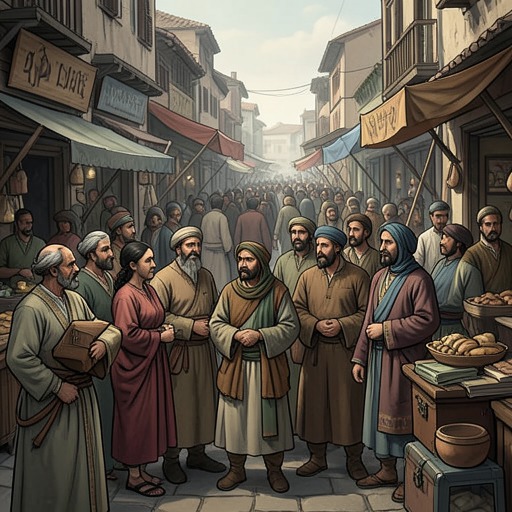
Bar-Jesus incident and Sergius Paulus's conversion at Paphos
Acts of the ApostlesThe Bar-Jesus incident and Sergius Paulus’s conversion at Paphos is a confrontation over who will guide a Roman governor’s understanding of the world: a Jewish magician who resists the disciples’ message, or the proclamation that the God of Israel is bringing the Realm through Jesus. When Paul, acting under the influence of the Holy Spirit, announces judgment against Bar-Jesus and the magician becomes blind, Sergius Paulus believes. The reversal gives this encounter a pointed significance in Luke’s account of the mission to Gentiles, while also exposing the story’s severe anti-Jewish framing.
Setting and Stakes
Paul, Barnabas, and John travel to Cyprus and make their way from the island’s eastern edge toward Paphos on the southwestern shore, stopping at synagogues as they go. At Paphos they encounter Sergius Paulus, the province’s proconsul, or Roman governor. He summons them because he wants to hear their message. The encounter therefore brings the disciples’ mission into the orbit of Roman provincial power: the person weighing their proclamation is not an anonymous listener but the official responsible for enacting Roman rule in Paphos.
With Sergius Paulus is Bar-Jesus, also called Elymas, a Jewish magician who may have served as the proconsul’s religious adviser. The account describes ancient magic as an effort to manipulate the universe’s forces, and treats Bar-Jesus’s practice as incompatible with Jewish communal prohibitions against magic. More important to the scene’s conflict, Bar-Jesus is presented as a false prophet who opposes the disciples and tries to turn the proconsul away from faith. His position beside the governor gives the dispute a social as well as theological stake: if Sergius Paulus accepts the disciples’ message, Bar-Jesus risks losing both the governor’s attention and the standing attached to their relationship.
The proconsul faces a choice between retaining the familiar alliance with Bar-Jesus and believing that the God of Israel is bringing the Realm through Jesus. The latter choice, as the commentary emphasizes, entails conflict with values and representatives of the old age. The scene thus makes conversion more than an inward change: Sergius Paulus’s response places him at a turning point in his relationship with the influential adviser already near him.
Paul’s Judgment and the Reversal
Bar-Jesus tries to dissuade Sergius Paulus from believing. Under the influence of the Holy Spirit, Paul identifies the magician’s theological and ethical inadequacy and becomes the channel through whom judgment is pronounced against him. The judgment takes a form that echoes the commentary’s account of Bar-Jesus’s spiritual condition: he becomes blind. The episode’s central reversal is stark. The figure presented as a religious guide is unable to see, while the Roman official who must choose between competing claims demonstrates discernment.
Sergius Paulus believes when he sees Bar-Jesus become blind. The visible consequence of Paul’s pronouncement is therefore followed immediately by the proconsul’s response; the account connects the magician’s loss of sight with the governor’s acceptance of the message. Sergius Paulus’s role as an agent of Roman rule sharpens the contrast. In the commentary’s reading, this Gentile official shows greater theological discernment than Bar-Jesus, whose Jewish identity does not prevent him from being portrayed as compromised by magic and cooperation with the devil.
The Wider Mission and Its Rhetorical Frame
The Paphos encounter is treated as part of Luke’s broader explanation of why many Jewish people turned away from the Realm and why the church should direct its energy toward Gentiles. That framing makes the proconsul’s belief consequential beyond the immediate exchange: a Gentile governor responds to the message while a Jewish magician attempts to block it. The episode thereby contributes to the narrative of an expanding mission, but does so through a contrast that risks turning particular characters into representatives of whole religious groups.
The commentary explicitly asks preachers to bring the anti-Jewish tone of this contrast to congregants’ attention. In its extended parallel with the dishonest manager in Luke, Bar-Jesus is compared to a figure who manipulates circumstances to preserve social position; the commentary says the magician’s temporary blindness illuminates the Pharisees as theologically blind and interprets their conduct as dishonest management. It sets that portrayal against the believing Gentile proconsul. This is not a neutral opposition: it draws on a sweeping negative characterization of Jewish figures, and the commentary warns that the parallel’s anti-Jewish tone must be named rather than passed over.
Ethical and Interpretive Consequences
The episode also invites examination of relationships in which powerful people or institutions become entangled with false values and manipulative practices. Bar-Jesus’s proximity to Sergius Paulus makes that concern concrete: influence can be sustained through an alliance, and the threat posed by a new message may lie in its capacity to unsettle the alliance. The commentary accordingly asks how communities manipulate relationships and circumstances, even crossing ethical boundaries, to maintain their own power. Bar-Jesus’s fate becomes a warning against such behavior, and the proconsul’s response an example of repentance.
The proconsul complicates any simple equation between political authority and theological failure. Sergius Paulus holds high social standing and serves a power that can be repressive, yet he recognizes the message in this encounter. The commentary therefore proposes that church communities ask whether people outside their usual Christian circles display greater ethical and theological insight than ordinary Christians, and urges them to welcome proconsul-like figures. Read alongside the warning about anti-Jewish rhetoric, this invitation resists using the scene merely to condemn an out-group: its ethical challenge also falls on the community that tells and interprets the story.
Narrative Significance
The encounter condenses a larger missionary argument into a contest over sight, influence, and belief. Bar-Jesus’s blindness makes the commentary’s interpretation of spiritual blindness visible, while Sergius Paulus’s belief gives the reversal a consequence for the mission. At the same time, the contrast carries a cost: by placing a Jewish magician against a Gentile believer, Luke’s account can support a hostile generalization about Jewish people. The episode’s significance therefore lies both in its depiction of the Gentile mission’s advance and in the need to scrutinize the anti-Jewish rhetoric through which that advance is narrated.